

Reaching The Peak
Although I’m unable to climb myself due to my disability. I have long been a fan of the sport, following climbers like Alex Honnold and Magnus Midtbo, amongst others. So it’s fair to say that from the moment I laid eyes on Cairn, the game immediately piqued my interest. What I didn’t expect was that Cairn would be a transformative experience, that has so much built on top of its foundation of climbing, that it would change the way I view games and what they can be.
While a straightforward game built around climbing isn’t terribly new, as titles like Jusant and even Peak, for what it is, offer something similar in their own way. Jusant, more so than Peak, provides a largely realistic way to scale a mountain, complete with a full physics system devoted to capturing some of the thrills of this sport. That said, while there are certainly some similarities, Cairn is a more grounded and narrative-heavy take on climbing that does significantly separate the two, despite their shared connection to the sport.
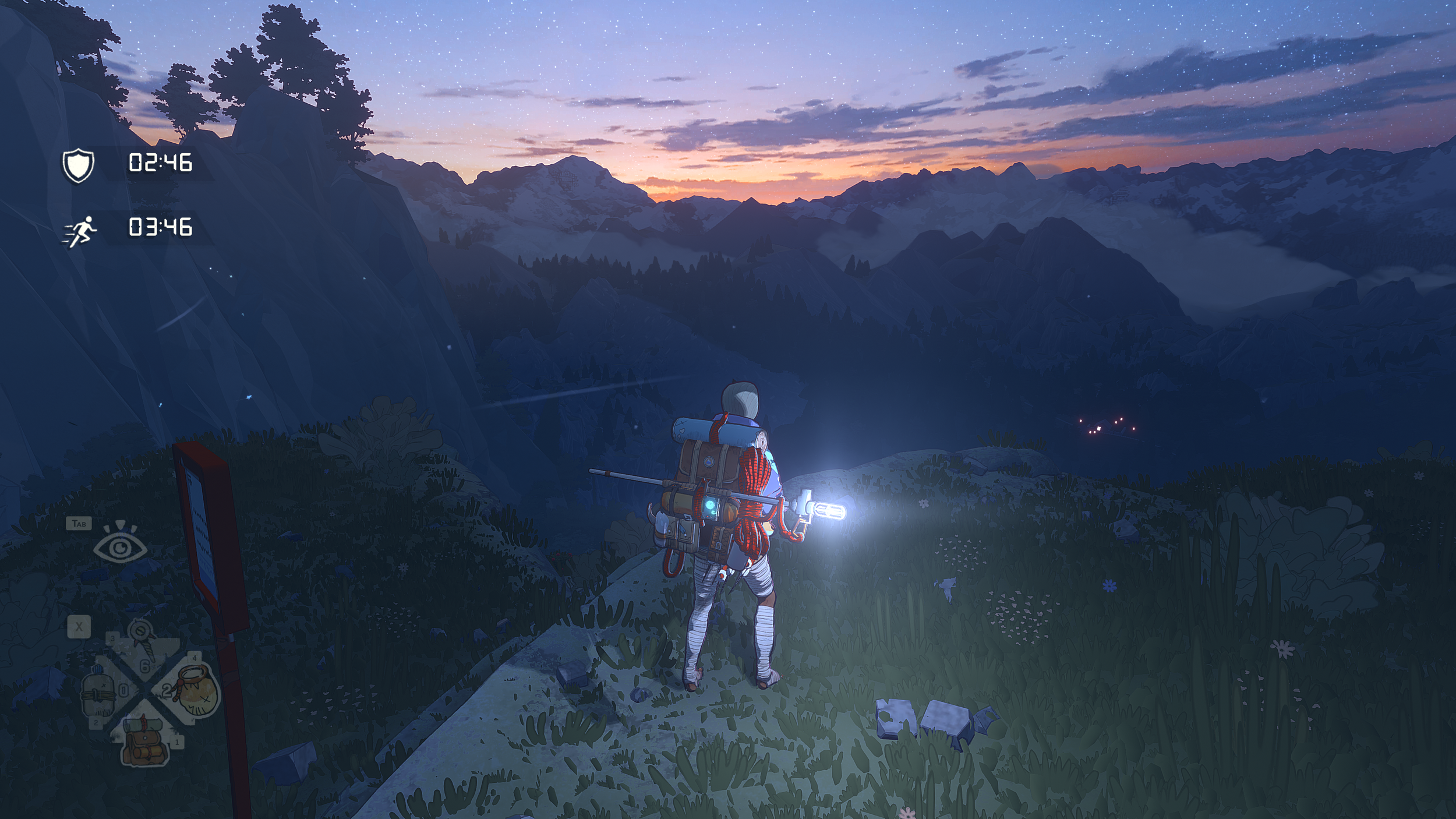
In Cairn, you play as Aava, a climber whose goal is to reach the summit of Kami, which is most easily described as this game’s Everest. You begin the game in a rock climbing centre with a tutorial that teaches you the basics of what you’ll spend most of your time doing… climbing. I highly recommend doing this tutorial even if you’re familiar with the dynamics of this sport yourself. What appears simple at first, you are able to move one limb at a time, pressing X on an Xbox controller to place your feet or hands accordingly. This then begins to get more complicated. Initially, the game will choose for you which leg or arm to move next, but then it teaches you that you can select the next limb to move yourself. This is done by holding the right bumper and using one of the sticks to select which foot or hand you want to move next.
Seems simple, but then you’ll learn about using pitons, which you can belay off of to regain stamina when required. Pitons are inserted into a rock face by holding up on the D-pad, which brings up a meter with three sections, one of which is pure white as the meter swings back and forth. You need to time a press of X to stop the meter in the pure white section.
This will result in a perfect piton insertion, whereas stopping the meter in either of the crossed sections will make the piton twisted. In that moment, this isn’t necessarily an issue, since a twisted piton can still be used to belay. However, once you retrieve them by sending your robot assistant to collect them with a quick press of Y, you’ll notice that any twisted pitons are broken and now require repairing.
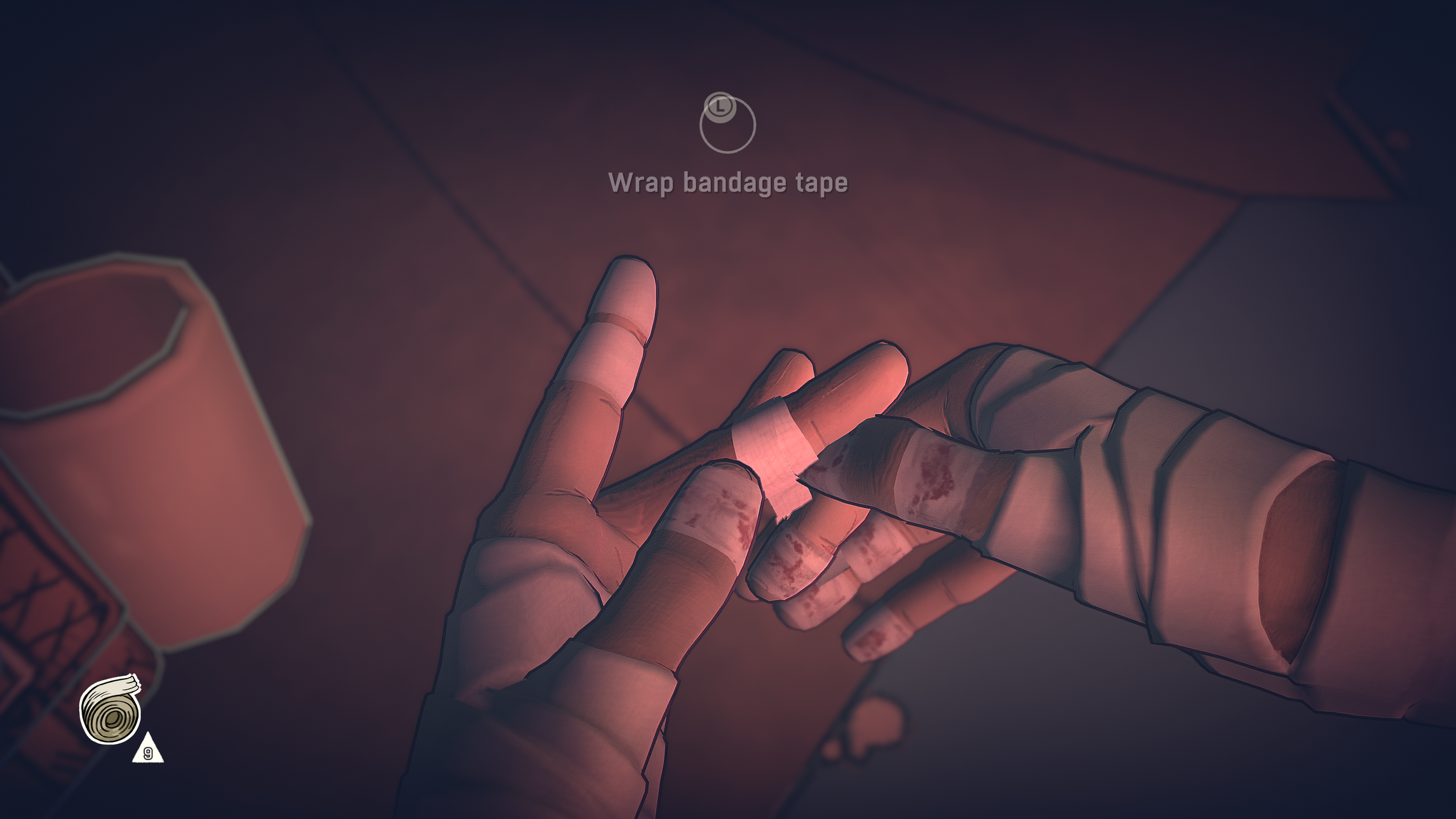
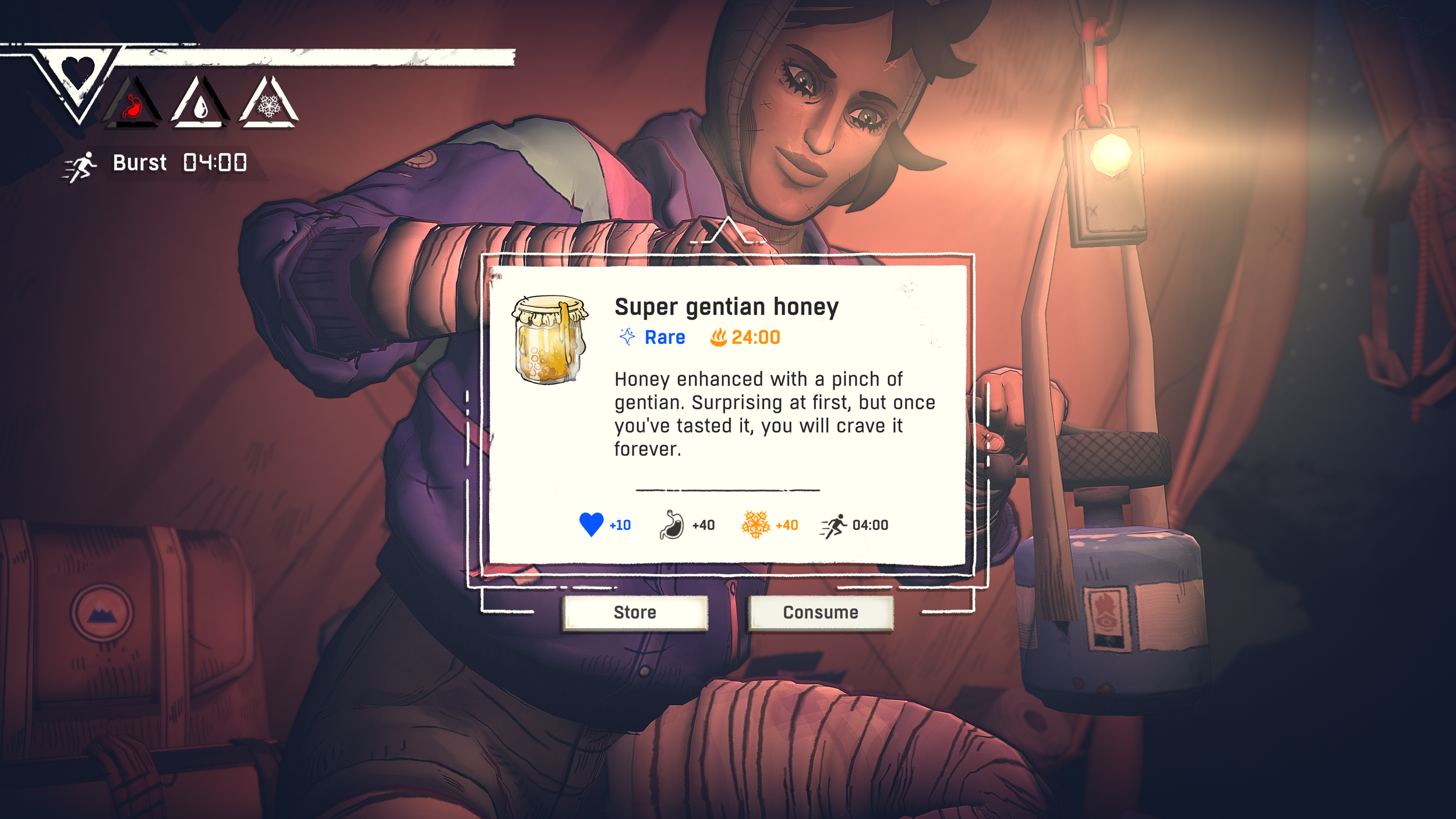
These repairs can only be carried out at your Bivouac, which you can only set up at specific locations along the climb to save your progress. Repairs aren’t all you’ll do in the Bivouac as it’s here that you can tape your hands to help maintain your grip, once existing tape has worn away. You’ll also cook meals or special concoctions here to replenish your hunger or give you temporary buffs to climbing and other abilities. These survival elements are light enough not to be overwhelming but in-depth enough to provide a challenging experience that requires you to think and plan ahead. Of course, you don’t often find survival elements without simulation elements, and the same is true in Cairn.
Being a climbing game, you can’t just climb up any wall that doesn’t have the appropriate handholds or footholds. Even when a wall does, if it rains, this will make climbing any wall with good holds, or not, infinitely more challenging and dangerous. Which is why you can also use the Bivouac to sleep, sheltering from rain or other bad weather. Just remember that while you sleep, your hunger and hydration will continue to drain. So, don’t rest for too long!
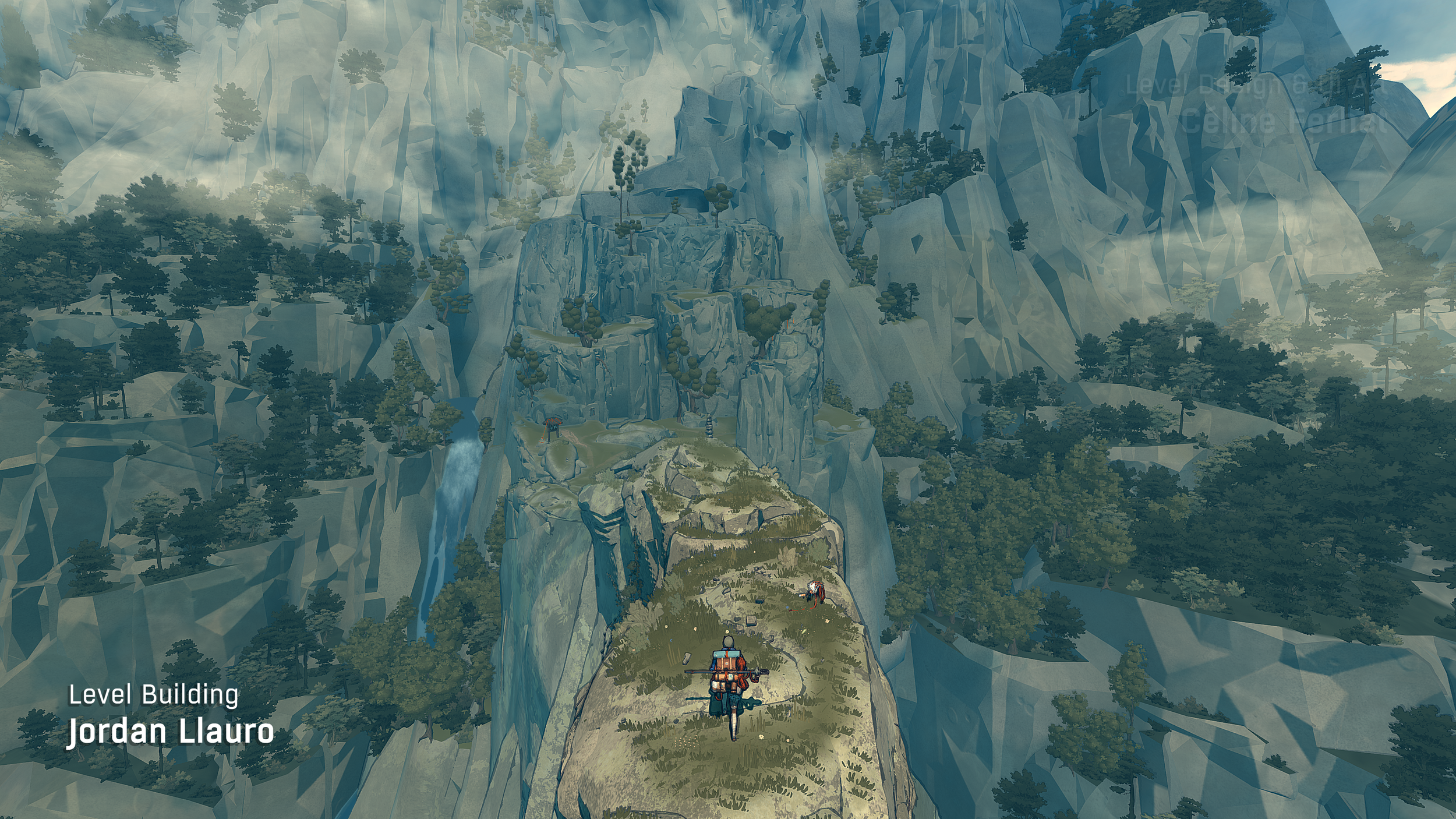
You start the game with a handful of resources, including food, tape, water, pitons, and medication for injuries, among others. When you’re out on the mountain, no one is coming to help you, and eventually you will run low on resources. Which brings me to the next major element of Cairn: exploration. You must explore to survive. This isn’t a sprint, it’s a marathon. Exploring Kami is delightful thanks to the game’s impeccable music, which is full of relaxing, almost zen vibes. The visuals add to the beauty of exploration, with pastel colors and a stylized hand-drawn quality to the art.
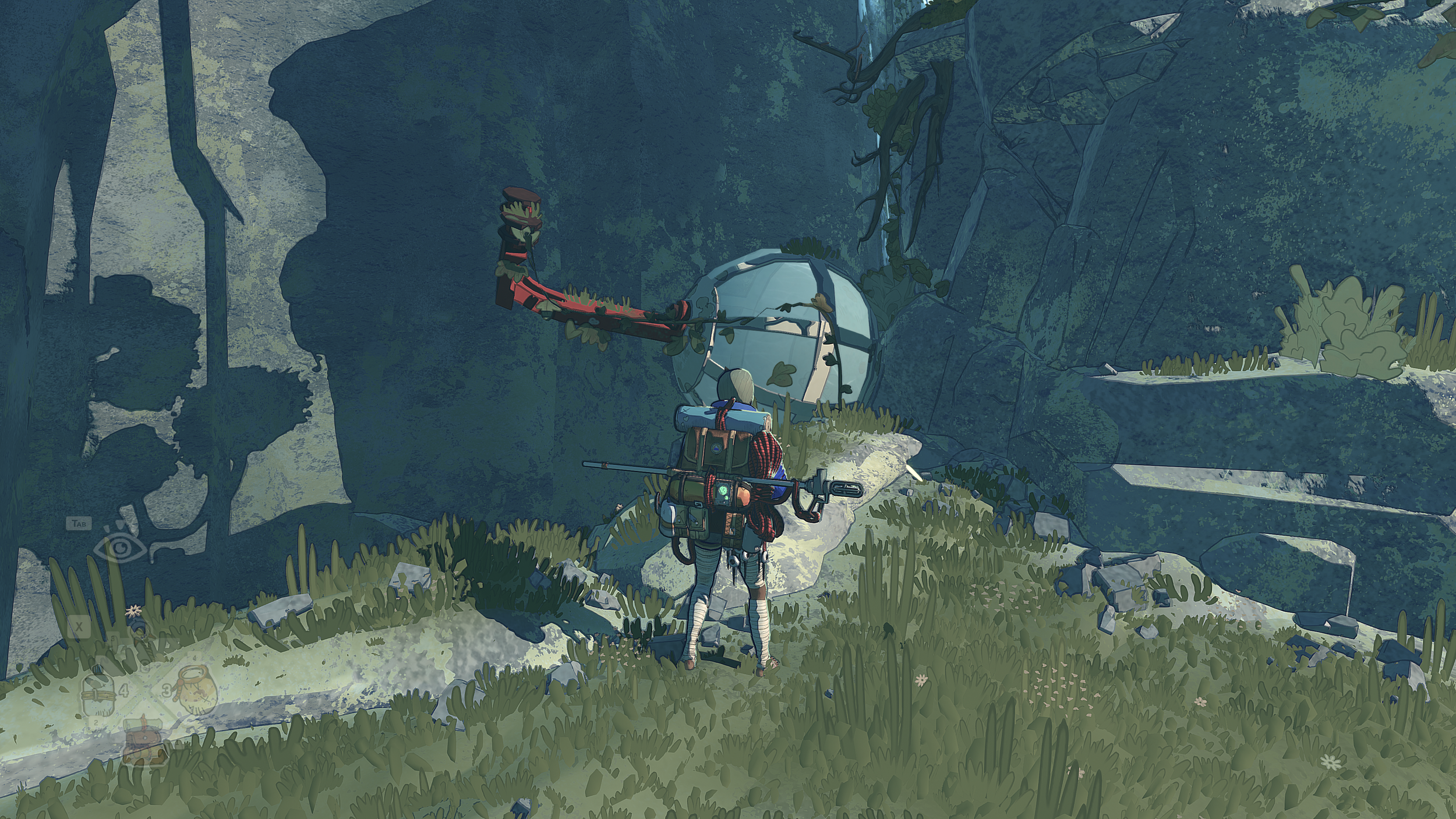
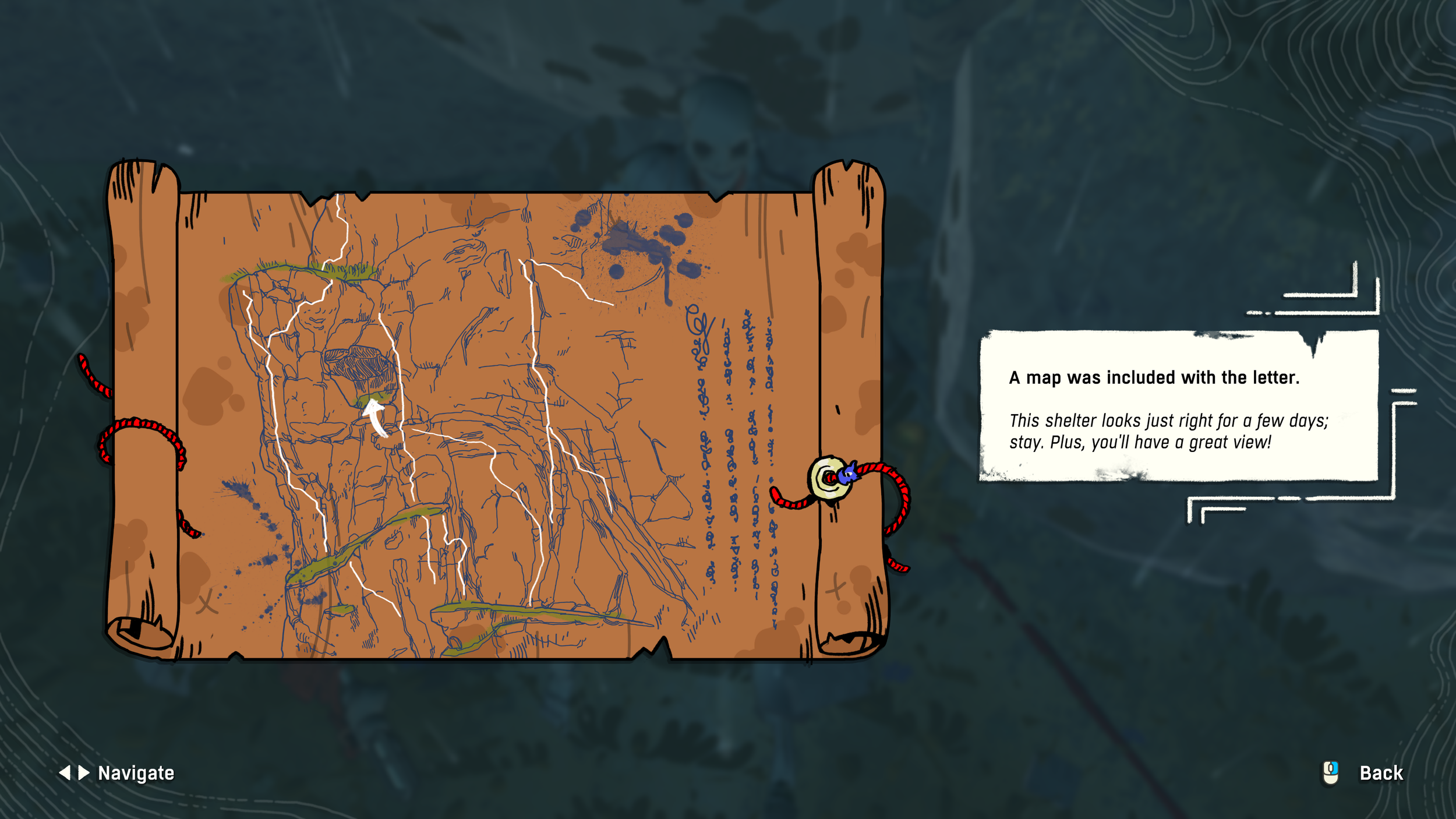
At times, Cairn can overload your senses, but in the correct way, transforming from a game into a reflective experience in quiet moments. That is, until you realize how tragic the story of Cairn is. While searching for supplies, you’ll often come across remnants of other climbers, with shelters, broken robots, a shrine to those lost on the mountain, and even the occasional body. Cairn is full of storytelling, with the biggest character being Kami itself and the power of nature over human life. The ways in which the story is told and the contents of it make Cairn one of the most grounded games I’ve ever played. For that reason alone, I’ll remember this game for years to come.
Most of the story is told through notes you find and the environments themselves. Cairn does have some voice acting, usually from Aava’s friend Chris and others, as heard in messages she receives from her robot assistant. Every word spoken feels full of emotions and it’s rare to see a game use voice acting in such a conservative yet effective manner.
Unfortunately, as much as I have loved every aspect of Cairn, I did encounter one bug that made things a lot more difficult for me, ultimately meaning I didn’t have time to finish the story itself before writing this review. I will absolutely continue playing until the end and probably far beyond.
After making great progress through the game, I loaded up for what I expected to be my final few hours, only to find that Pitons were no longer working for me. Despite having six of them equipped, the option to use them was constantly greyed out. So, I guess the game decided it wanted me to become Alex Honnold, but Kami isn’t El Cap, guys! I eventually managed to fix this by uninstalling and reinstalling the game, but it’s a shame because it was the only issue I had with the game.
Of course, some of you might actually want to Free Solo your way up Kami, and you can do that. Cairn’s hardest difficulty is titled Free Solo, and as the name suggests, it means no Pitons, no Belaying, and harder to manage survival aspects. This is a mode I hope to try eventually, but for this review, I played on the default normal difficulty. There is also an easier option for those who want to focus on the story above all else.
We are reaching the end of this Cairn review, and I can summarize it like this: Cairn reaches not only the peak of its genre but the peak of gaming itself. Built on top of the foundation of climbing is one of the most beautiful, transformative experiences I’ve ever had in life, not just gaming. Whether you like climbing or not, Cairn is a game I recommend to everyone, and it’s a journey I expect people to remember for years to come.

Developer - The Game Bakers
Publisher - The Game Bakers
Released - January 29th, 2026
Available On - PS5, PC
Rated - (M) - Strong Language, Use of Drugs
Platform Reviewed - PC
Review Access - A review code for Cairn was provided by the publisher for the purpose of this review.
I’m Jordan I have a background in game design and am deeply passionate about accessibility in gaming. My favourite games/franchises include Shenmue, Red Dead Redemption 2, Plague Tale: Requiem, Metal Gear Solid 3, Yakuza, Splinter Cell, and Assassin’s Creed.