
A Blast Through The Past
I’m no stranger to the soulslike genre, having played the likes of Elden Ring, Wu Chang: Fallen Feathers, and Lies of P, over the last few years. Being a more recent fan of this style of character action game, I have only played a small portion of the first two Nioh games. Still, that hasn’t stopped me from diving headfirst into Nioh 3. Does this game have the magic required to stand out amongst the competition? I believe it does, and not only that, but it might be my favourite soulslike game I’ve played thus far.
Despite that praise, Nioh 3 isn’t a revolutionary game, but it leans heavily into fast-paced action and a deep variety of combat options, building on the strengths of the previous two titles. For example, this time round, you can switch between Samurai and Ninja classes on the fly with a quick tap of the right trigger. This is something you’ll need to do to parry certain unblockable attacks; these are indicated by a red glow, and what you’d expect to see in this type of game.
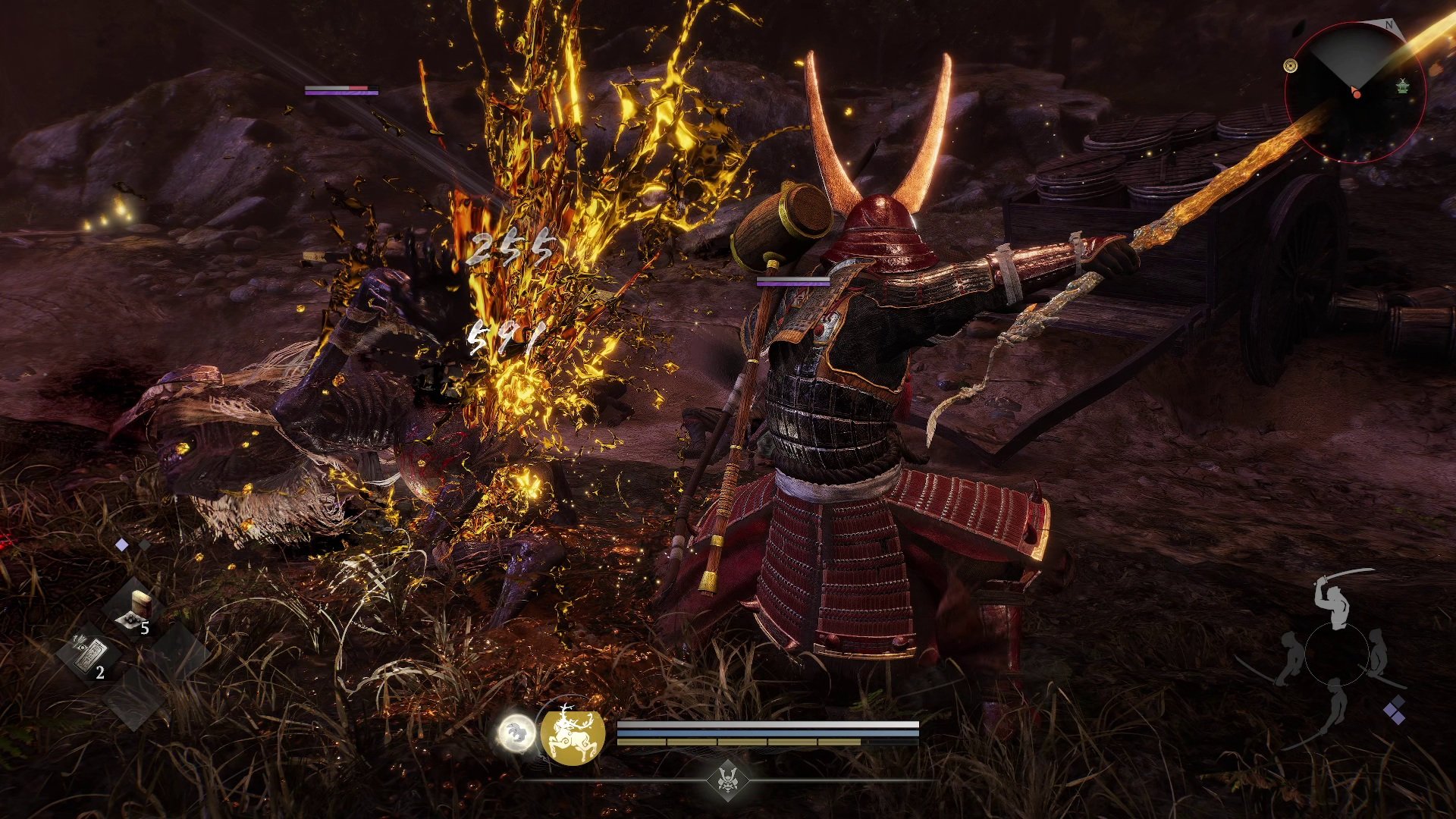
What surprised me is how different the two classes play and the variety of options each one has in terms of skills and weapons. If you’ve played the previous Nioh games, then you’ll be familiar with the Samurai’s arsenal, from Odachi, Swords, Axes, and more. When combined with the ability to switch between high, middle, or low stances and the fact that you can unlock different attacks for each weapon using Samurai points, which you earn by defeating bosses or finding them in loot boxes. The Samurai class offers so many different combinations and play styles that my friend's Samurai was completely different from mine.
This is before we even get to the Ninja, who, as you might imagine, is faster but takes more damage than the Samurai. I guess you could say the Ninja is like your damage per second class, whereas the Samurai is more like a tank. However, this isn’t the only way that the two differ, not at all.
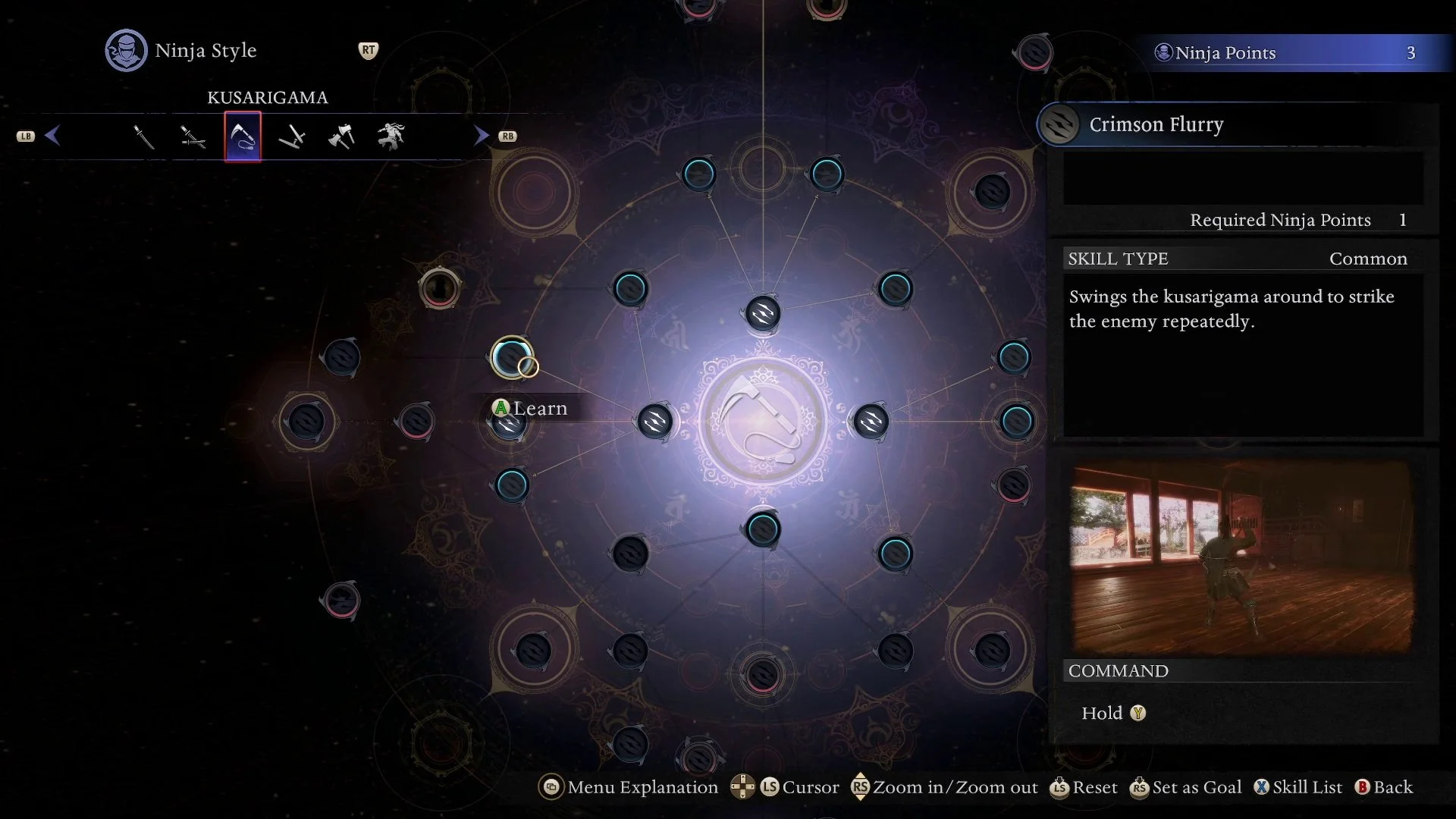
Ninjas have their own weapons and skills; they also have Ninjitsu Tools to use instead of stances to change. These tools can be upgraded and changed in the Ninja skill tree using Ninja points, which you earn in exactly the same way as the Samurai points. Again, this adds so much depth and build variety, meaning that everyone's Ninja should have at least a few significant differences. For example, I use talons, like wolverine claws, and my setup relies on Ninjitsu Tools to be successful. However, you might want to use dual swords, a kusarigama, or something else entirely.
No matter which class and weapon you choose, one thing remains true across all combat encounters in Nioh 3. They remain fast-paced and high-octane in both the open-world areas and in the arena boss fights. It is the equivalent of having your cake and eating it too.
The Ki system also returns, meaning that for the Samurai, you have to press the right bumper after attacking to refill stamina. Technically, you don’t have to, but you’re going to run into issues very quickly if you don’t. Ki is less important for the Ninja as it refills much faster for that class. That said, a well-timed press of the right bumper after a quick attack lets you shadow step, which is like a dodge but better. Shadow step will leave behind a ghost of your previous position, and this ghost temporarily draws the enemy's attention.
Talking about enemies, the variety in Nioh 3 is great, whether they be Yokai or Human foes, there are so many different types to encounter and master their patterns. From slow heavy-hitting brutes to sentient puddles, living doors, and even umbrellas. I rarely see this level of enemy variety in any game, let alone just in the soulslike genre.
It’s this enemy variety that helps keep every combat encounter feeling fresh, even long after you’ve settled on a specific weapon and skills for each class. I have never enjoyed combat more in gaming, so in that regard, Nioh 3 sets a new standard.
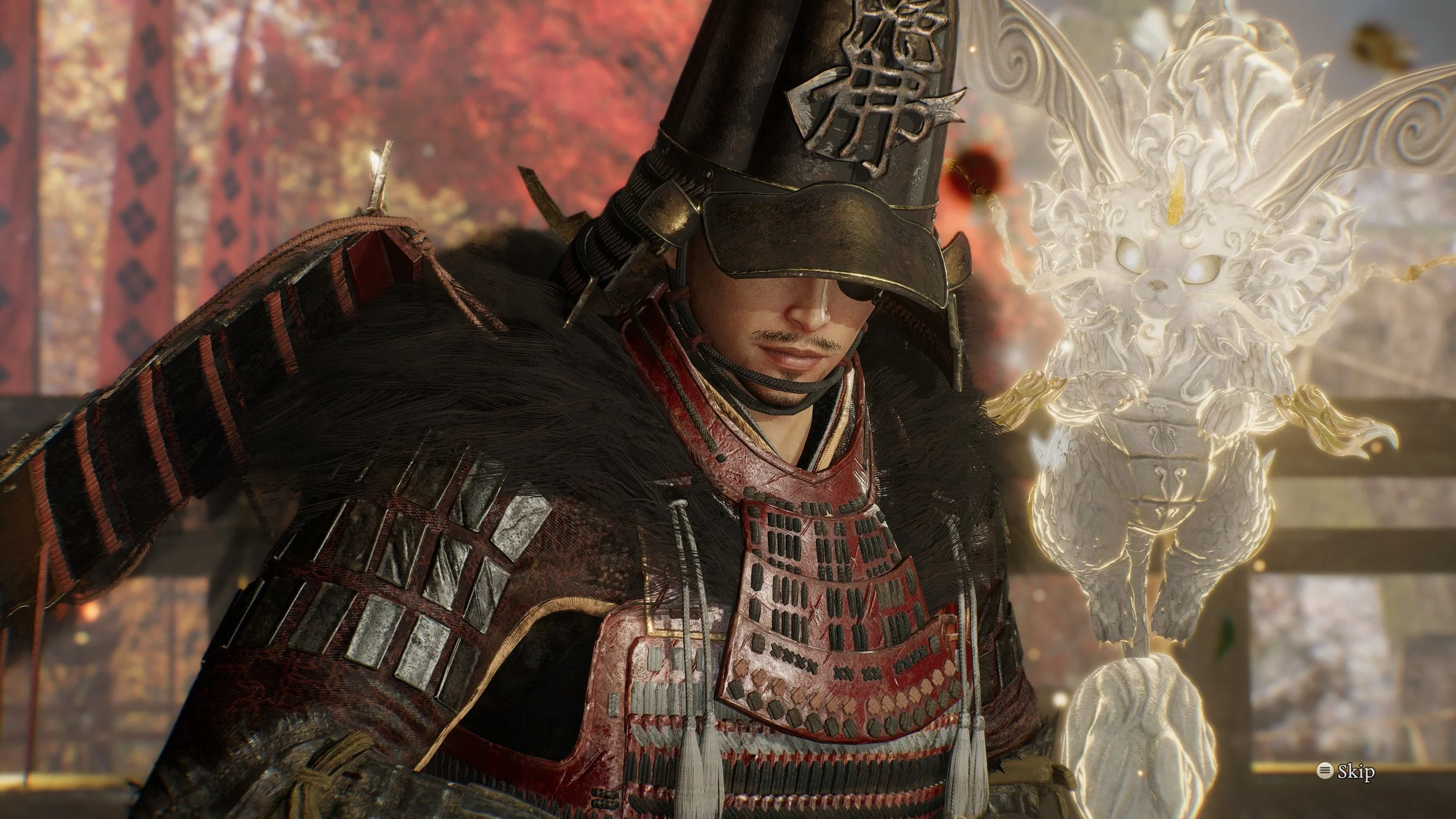
Combat does have one other crucial element, that being your guardian spirit, which is like the living weapon and yokai shift mechanics in Nioh 1 and Nioh 2, respectively. Charging your spirit meter throughout combat with attacks, parries, and more, you’ll eventually be able to use guardian spirit abilities. These abilities can be activated through holding the left trigger and pressing either X or Y on an Xbox controller. Unleashing powerful elemental-based attacks that differ depending on which guarding spirit you have equipped.
Eventually, you are able to use your ultimate ability, awakening and transforming into your guardian spirit for a short period of time. While the ultimate takes a lot longer to charge, the power of it can be the difference between life and death, especially during a boss fight.
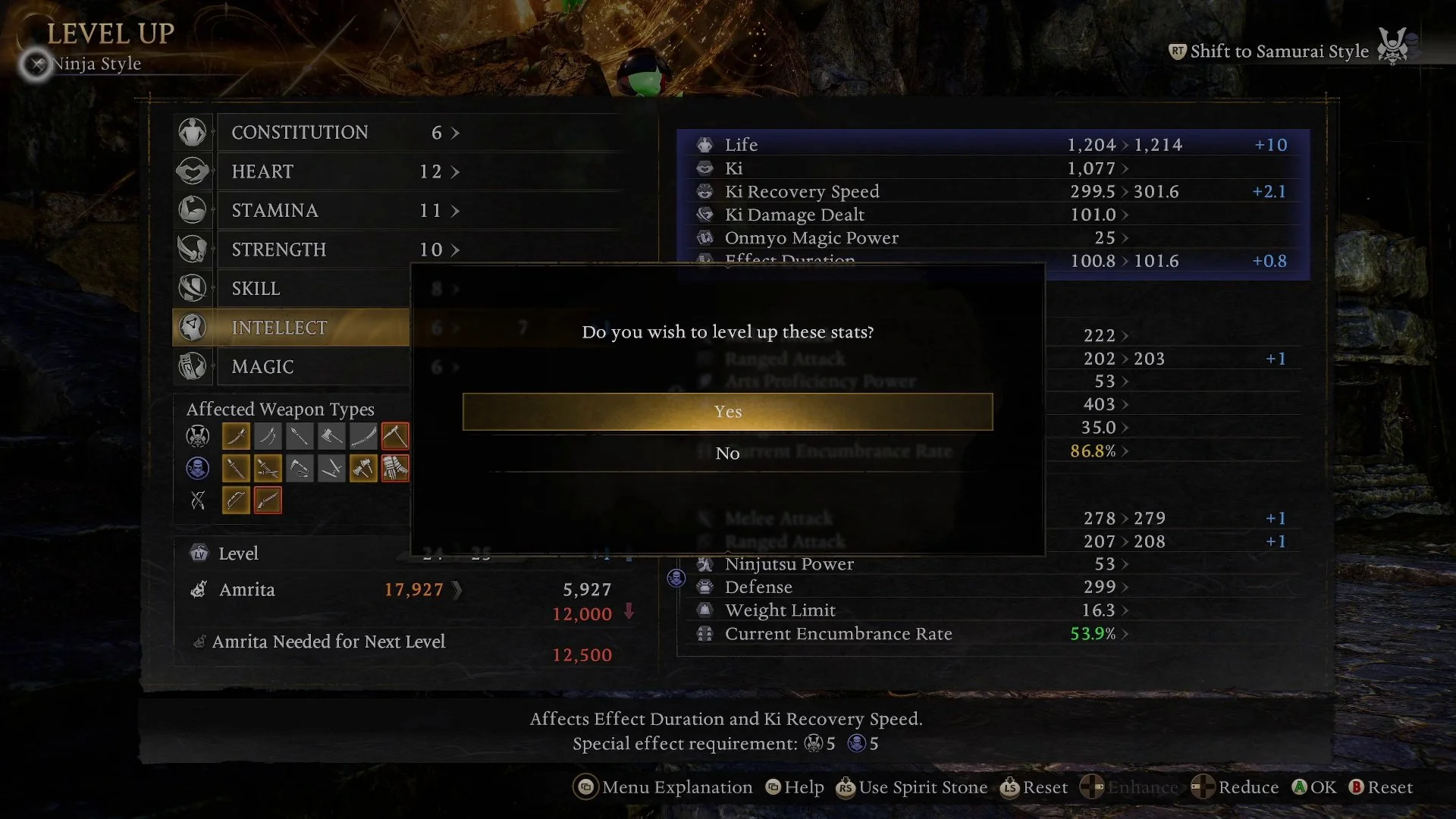
Now, let’s talk about progression, because I already mentioned skill points and how you get them, but that is only one aspect of progression. Of course, we also have a levelling system where you earn Amrita by killing enemies and losing it when you die, but earning enough will allow you to level up at any shrine, Nioh’s version of bonfires. Each level is a point which you can allocate to one of seven stats: Constitution, Heart, Stamina, Strength, Skill, Intellect, and Magic, and these stats all affect different weapons. So, make sure you’re leveling the attributes most relevant to your loadout.
If you do make a mistake in leveling, don’t worry too much; you can reset and reallocate your levels at no extra cost by pressing the left stick. This is something I wish more soulslike games offered, because having that flexibility helps you experiment with different playstyles and weapons. Ultimately, it helps make the game even more fun, and that’s what matters the most.
Speaking of things I wish more soulslike games did, Nioh 3’s approach to co-op is amongst the best I’ve seen. You don’t need to go off and find a random item just to play with your friends. All you need to do is go to a shrine and set up an expedition, which you can make private with a code or open to friends only. Once your friend is in, you can play the whole game together. Just keep in mind that, depending on whether you choose story mode, expedition, or mission mode, the way they function is slightly different. The game explains this in a detailed pop-up the first time you set up an expedition, but in simple terms, Story mode is the one you want. It allows you to essentially play the entire game together, whereas Mission mode, as the name suggests, is designed for replaying or completing specific missions.
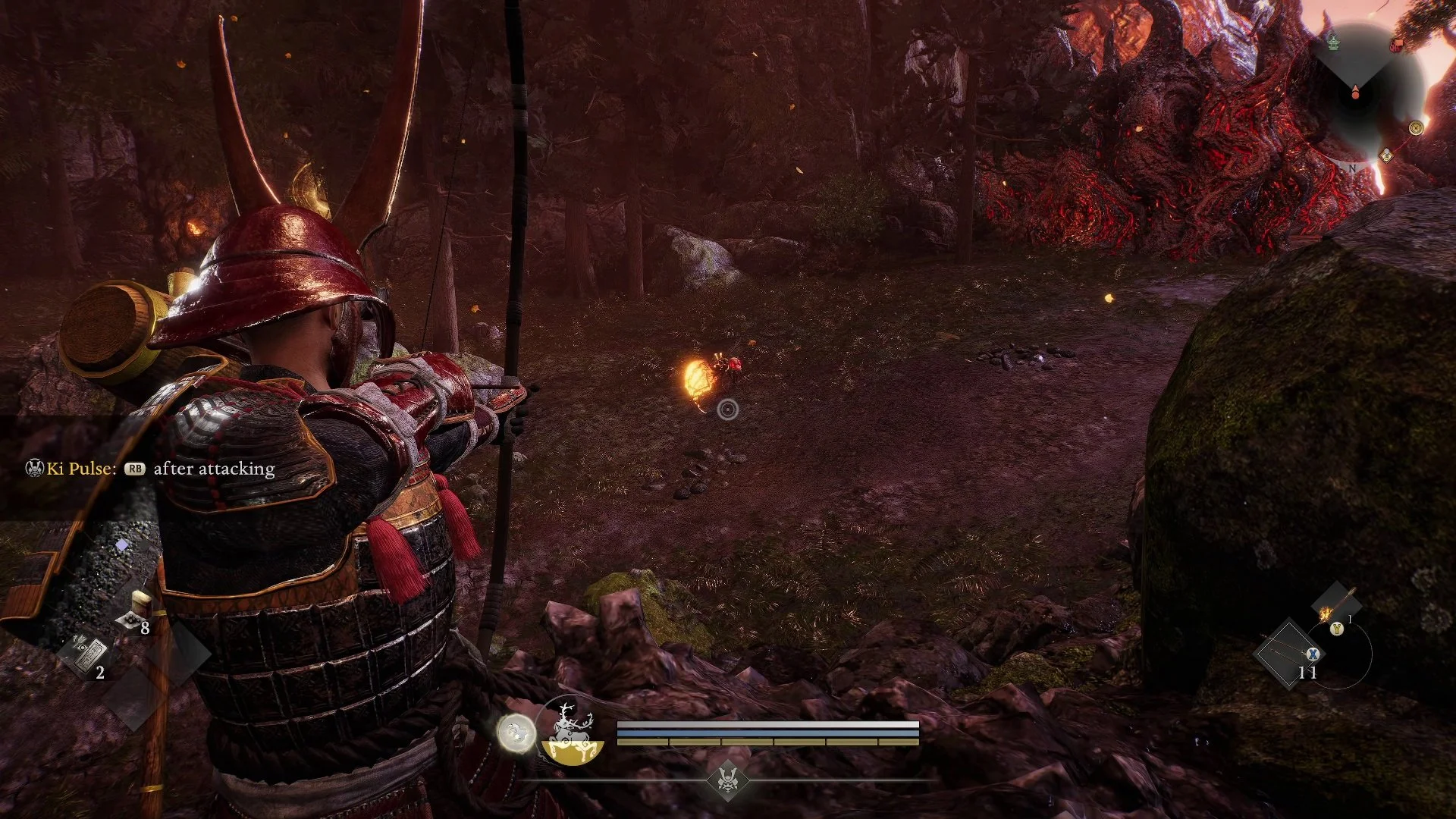
Of my 30 hours spent with the game so far, I have played around half of that with fellow Nioh 3 reviewer, Keith Mitchell of The Outerhaven, and outside of a couple of random disconnections, which may or may not be the fault of the game, co-op in Nioh 3 has been a brilliant experience, and one that I’d highly recommend.
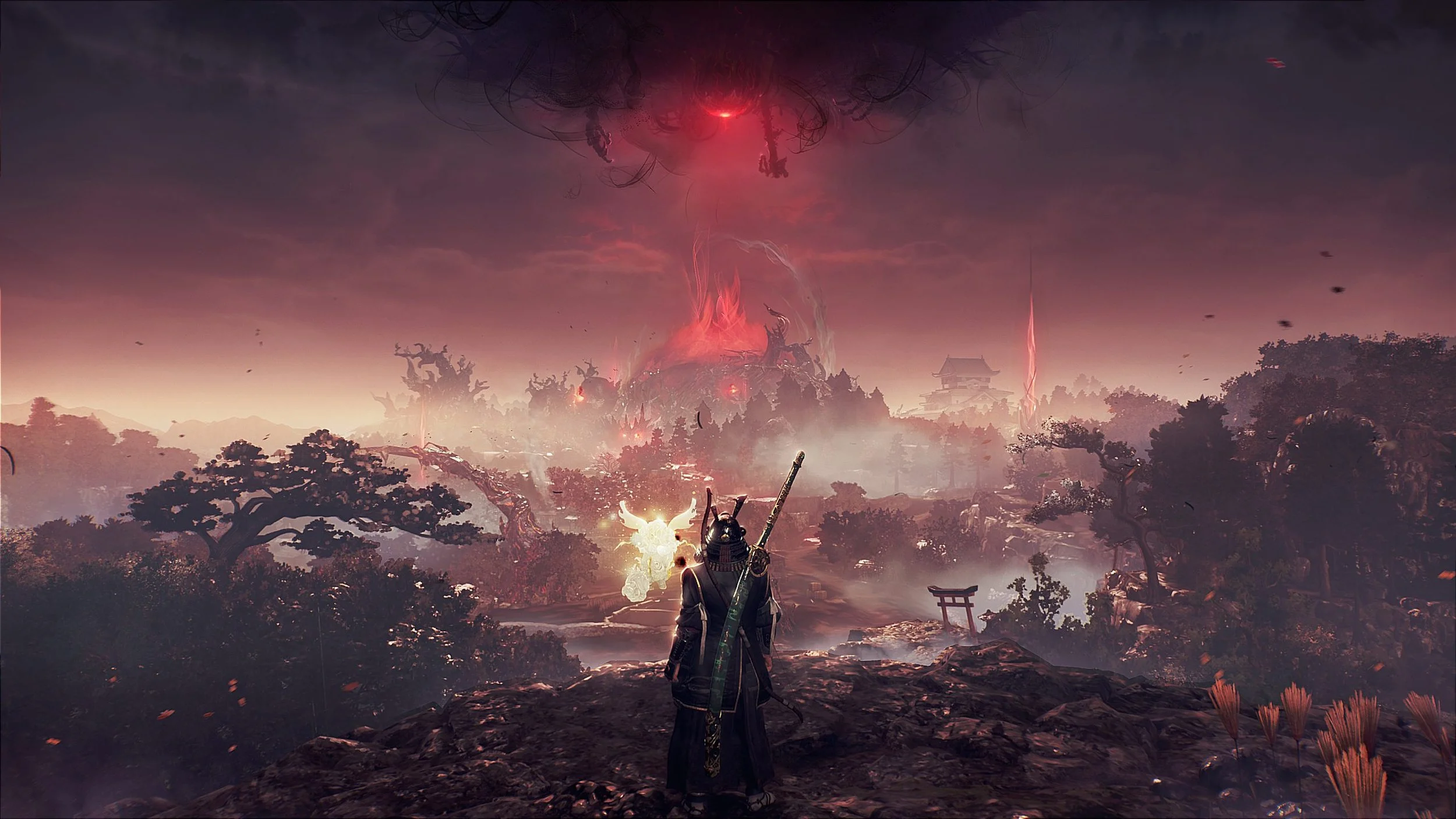
Another aspect of Nioh 3 that I found extremely impressive was its open-area system. Developer Koei Tecmo refrained from calling the game an open-world, but in truth, I think they should. The world and exploration of Nioh 3 is fantastic; you never know what you’re about to find around the next corner. Sure, it’s not fully seamless like many open worlds today, but it’s more alive and interesting than most of them. With Nioh 3 having different maps for each time period you travel to as part of the main story also helps to lend the world some much-needed variety.
Just as one map gets a little stale, you’re moving on to the next era, and it looks very different. Not only that, but each map has different environmental characteristics that provide a challenge to overcome. Away from the main quest, there are many collectibles and side quests to complete, and doing so not only helps build on the world and its lore. These additional activities also give you unique equipment or buffs that help you on your journey.
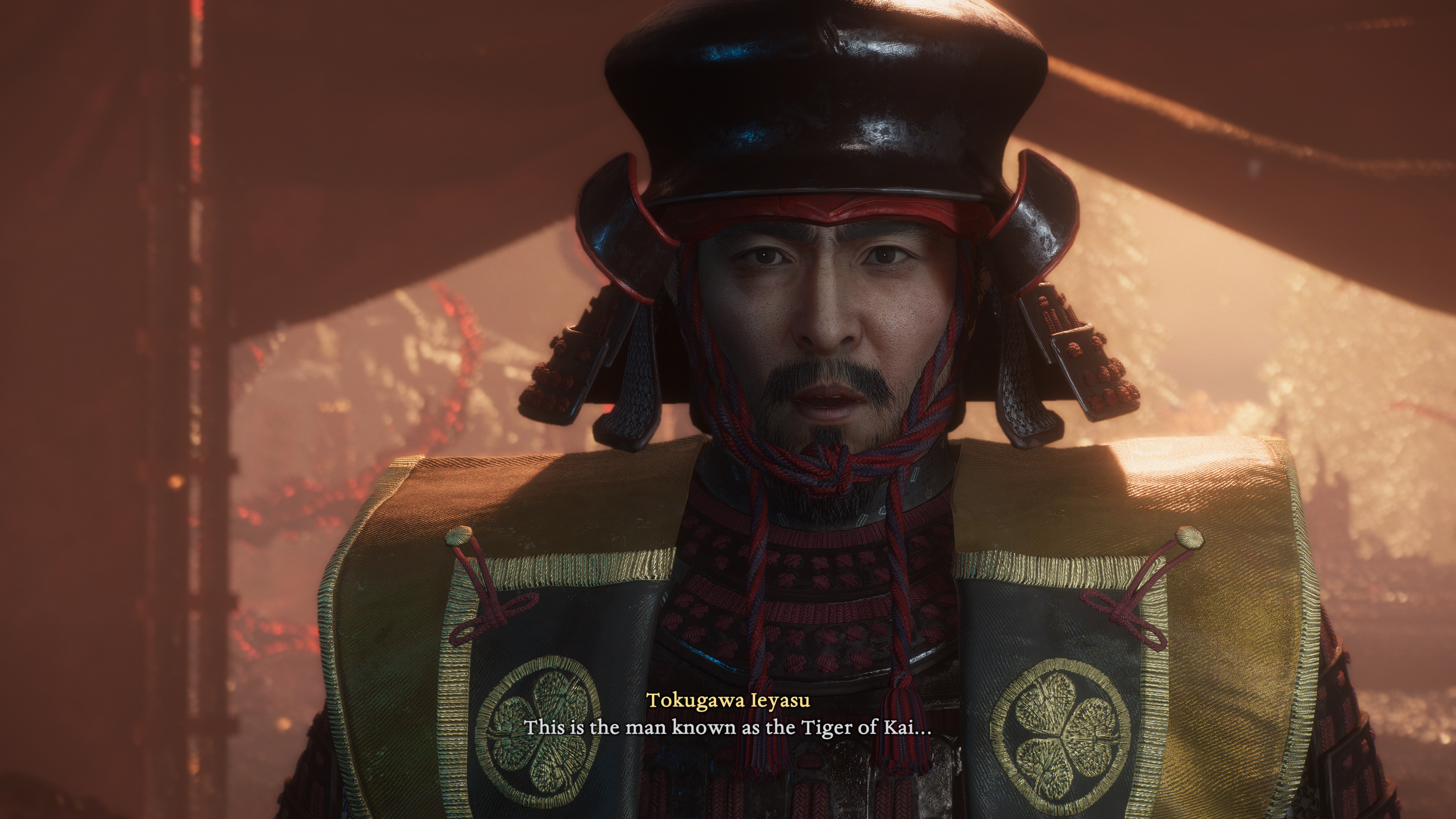
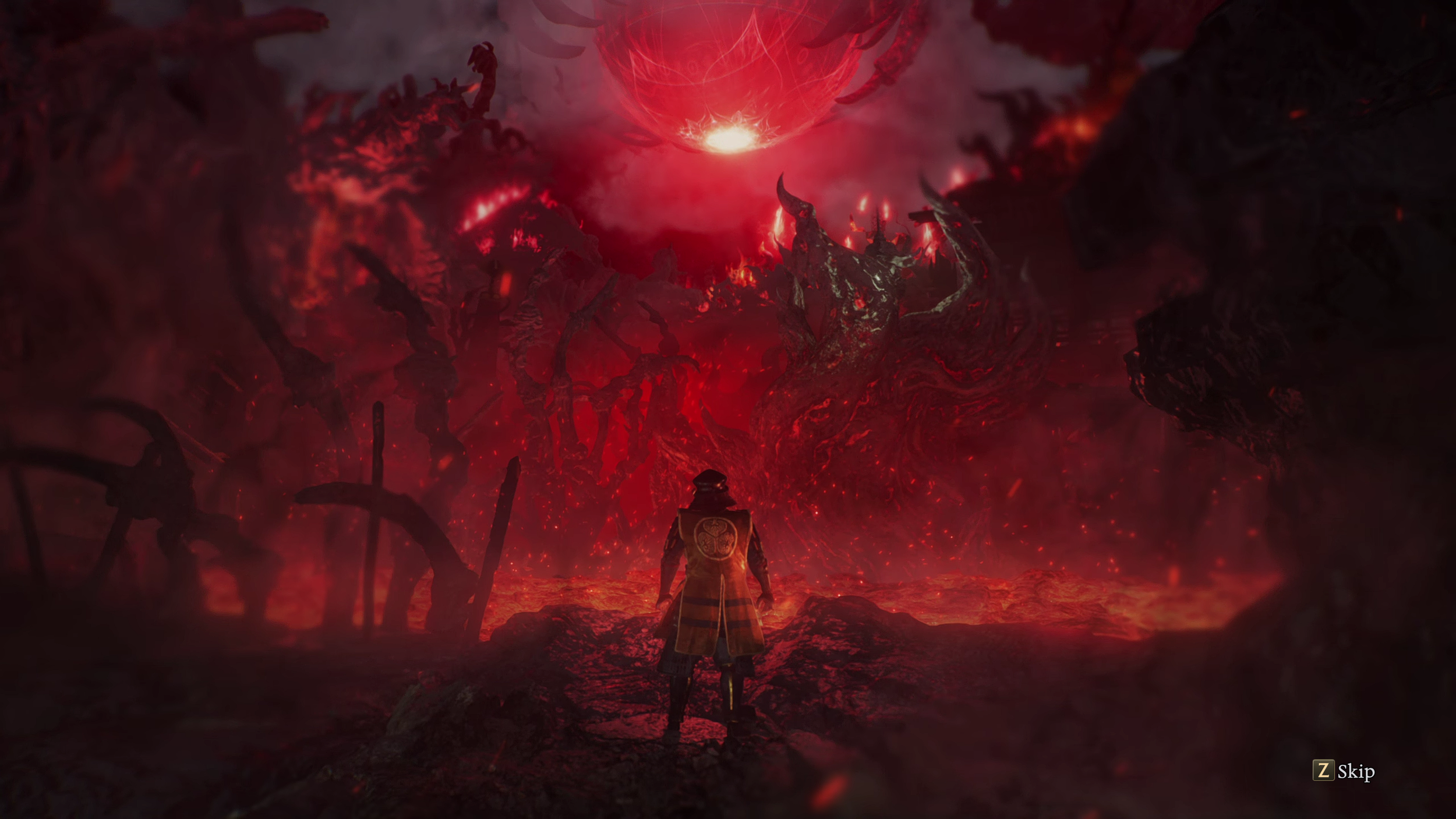
I won’t pretend to have a concrete idea of what is going on in the story itself, since it’s more complicated than a Hideo Kojima game. However, I do appreciate that Nioh 3 puts a heavy emphasis on story, with many brilliant action cutscenes in particular. Having a more traditional form of storytelling in a soulslike game is something I always look for, and in that respect, Nioh 3 is the closest to what I want out of this genre storywise. Even if the overarching narrative is difficult to understand, the cinematography is a step up from its genre competitors.
This cinematic approach is obviously helped greatly by the visual and audio presentation, as without it, the focus on cutscenes wouldn’t work. Although results are mixed depending on what you're looking at or listening to.
For example, environments, especially on PC with the highest available graphics settings, are beautiful. Aside from some overly aggressive pop-ins in certain areas of the open world, Nioh 3 is a great-looking video game; even the main NPC characters look good both in and out of cutscenes. Unfortunately, the same can’t be said for your player character, as they stick out like a sore thumb. That is a reasonable price to pay for a great character creator. Nioh 3’s character creation suite is the best I’ve seen in a long-time across gaming outside of the WWE 2K franchise.
However, your created character isn’t the only aspect of the game’s presentation that sticks out as being of lesser quality. The English voice acting, while serviceable, isn’t great, with characters often mispronouncing certain words, especially “crucible,” and at times the lip-syncing can also feel off. I want to stress that the voice acting isn’t bad, but it isn’t good and ultimately becomes distracting most of the time. Particularly when compared with the rest of Nioh 3’s audio presentation, which is outstanding. From firing guns, shooting arrows, and the clashing of swords, to the music and ambient sounds used to help guide you towards collectibles, everything is remarkably well crafted. The sound effects in Nioh 3 are top-class. I just wish the voice acting could reach that same level of quality.
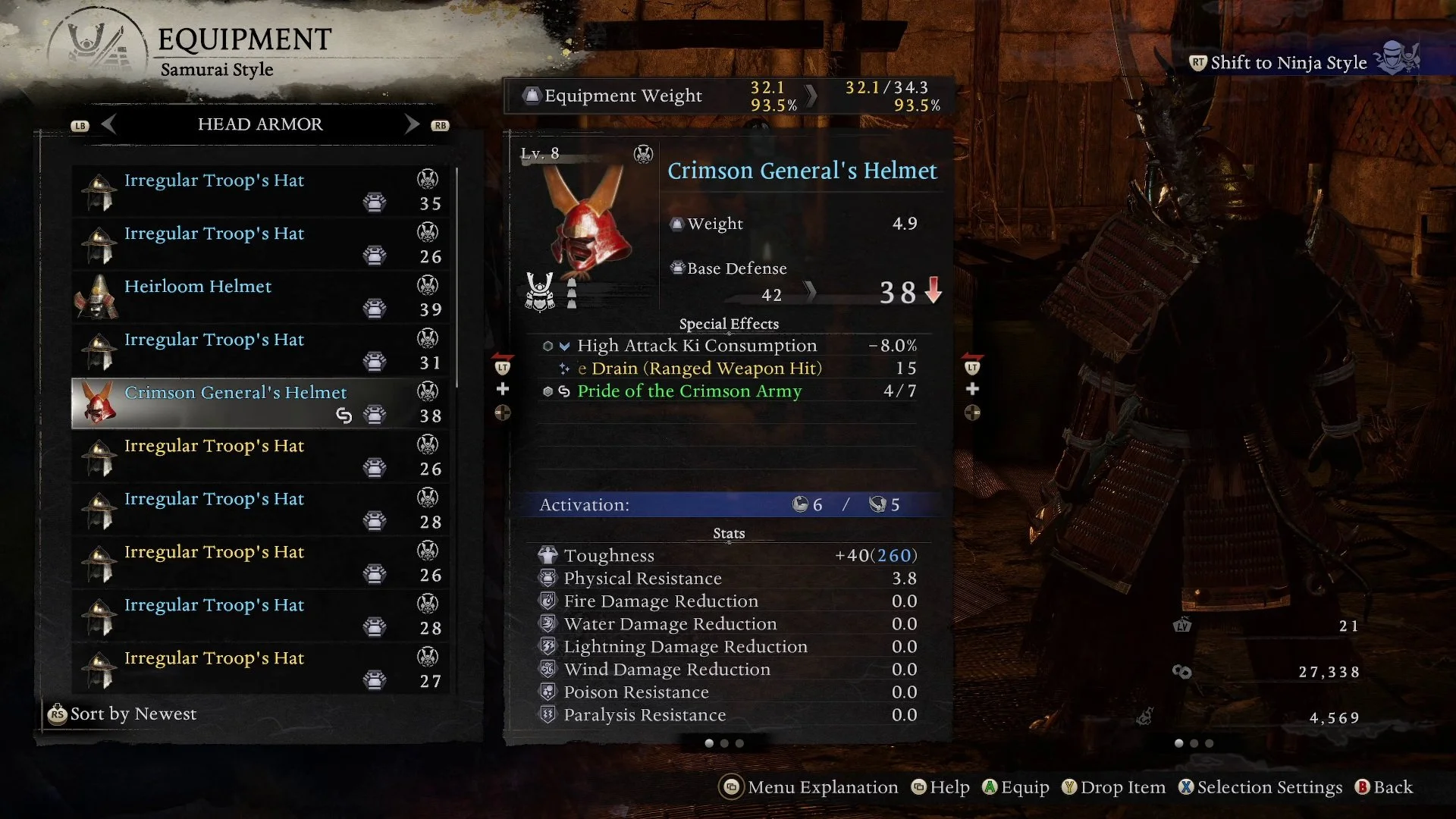
A quick note on PC performance, while playing at 4K resolution with DLAA enabled on the highest graphical options that Nioh 3 offers. I was getting a locked 60 frames per second, with only a few single-digit frame drops in heavier scenes.
On the face of it, that might sound excellent, and I do appreciate the steady performance. But when you factor in my high-end hardware (listed below), I do worry about how the game might perform on less capable machines. My worries were only heightened when I saw that setting DLSS to 50% resolution scale only got me to around 100 fps. Leaving me with the feeling that additional optimization is needed in order to get the best performance out of Nioh 3.
Jordan’s PC Specs: AMD 9950X3D, RTX 5090 Founders Edition, 96GB DDR5 6000MHz Corsair RAM
Speaking of optimization, during my playtime, I ran into several bugs and technical issues. Occasionally, enemy health bars would fully disappear, or enemies would stand in corners like I wasn’t there, despite the fact that I just decapitated their friend (though this could just be down to bad AI). The worst issue I encountered was a fatal error that occurs nearly every time I quit the game; it hasn’t yet affected my save, but it could, and that is a significant worry.
I could spend so much longer talking about Nioh 3, but then we would honestly be here all day. So, I’ll summarise like this: if you’ve played the Nioh games before, then you largely know what to expect here: fast-paced, challenging action with some of the toughest boss fights in the genre, but the addition of the Ninja class gives you more ways to play than ever before.
If you haven’t played Nioh before but you enjoy soulslikes and character action games, then this is definitely a game you need to try. Its focus on player choice in approach, combined with more cinematic storytelling than its competition have made it my favourite game in the genre so far. It’s a game that I plan to continue playing in the coming weeks, once I can get through this dreaded boss wall I have currently hit. One thing I know for sure is that the sense of reward you get from beating a boss in Nioh 3 is greater than any soulslike I’ve played before.
Developer - Koei Tecmo (Team Ninja)
Publisher - Koei Tecmo
Released - January 29th, 2026
Available On - PS5, PC
Rated - (M) - Blood and Gore, Suggestive Themes, Violence, Users Interact, In-Game Purchase
Platform Reviewed - PC
Review Access - A review code for Nioh 3 was provided by the publisher for the purpose of this review.
I’m Jordan I have a background in game design and am deeply passionate about accessibility in gaming. My favourite games/franchises include Shenmue, Red Dead Redemption 2, Plague Tale: Requiem, Metal Gear Solid 3, Yakuza, Splinter Cell, and Assassin’s Creed.